Does an Infrared Sauna Add Value to Your Home?

An infrared sauna rarely adds value dollar for dollar against its purchase and installation cost, but a well-placed, permanently installed cabin can support a higher asking price in wellness-minded markets and shorten time on market when buyers are comparing similar homes. A portable plug-in unit is usually treated as personal property at resale, not a fixed improvement, so the value question comes down mostly to how and where the unit is installed.
Step 1: Decide Whether the Sauna Will Be Fixed or Portable
This is the decision that determines almost everything else. A cabin hardwired into a dedicated circuit, sitting on a finished floor in a basement or spare room, reads to an appraiser and to buyers as part of the house, similar to a built-in wine fridge. A plug-in unit sitting on carpet or a patio, using a standard 120V outlet, reads as furniture that could leave with the seller. Neither choice is wrong, but only the fixed installation has a real chance of factoring into an appraisal or a buyer’s mental math on offer price.
Step 2: Match the Installation to the Local Buyer Pool
A carbon-panel cabin in a home aimed at a wellness-conscious, higher-budget buyer pool can be a genuine differentiator, the kind of feature that gets mentioned in listing photos and shows up in showing feedback. In a starter-home market where buyers are focused on bedroom count, school zone, and move-in readiness, the same sauna is more likely to be seen as a curiosity that takes up a room rather than a value driver. Before investing heavily in placement or finish quality, it is worth looking at what comparable recently sold homes in the neighborhood actually featured, and whether anything wellness-adjacent, like a home gym or a sauna, showed up in their listing descriptions.
See also: Why Delhi Is Becoming a Global Hub for Modern Business Travel
Step 3: Choose a Location That Reads as a Room, Not Storage
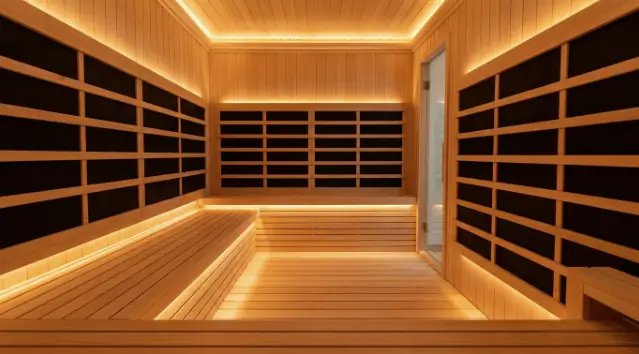
Placement inside the home matters more than most sellers expect. A cabin tucked into a corner of an unfinished basement next to a furnace and water heater reads as clutter. The same cabin in a finished room with proper flooring, ventilation, and a clear walking path reads as an amenity. Low-EMF carbon or ceramic panels run cool enough on the exterior that a finished, well-lit installation does not need special safety barriers beyond normal clearance from the panels, which makes a clean, intentional-looking room achievable in a spare bedroom or a corner of a finished basement without much extra work.
Flooring choice matters for the same reason. A cabin sitting on bare concrete or mismatched carpet remnant reads as an afterthought, while the same unit on a water-resistant tile or vinyl plank floor, matched to the rest of the finished space, reads as a planned feature. Ventilation is a smaller but real detail too: a small exhaust fan or a vent to the outside keeps the surrounding room from feeling humid after a session, which matters if the sauna shares space with a home gym or a laundry area that a buyer will also be walking through during a showing.
Step 4: Understand What the Cost Actually Buys
Most one- to two-person infrared cabins run $2,000 to $4,000 for the unit itself, with basic installation adding a few hundred dollars if an outlet already exists nearby. That is a modest renovation cost compared to a kitchen or bathroom remodel, which is part of why sauna additions rarely show up as a line item that recoups its full cost at resale the way a major kitchen update sometimes can. Buyers researching options can compare current model pricing and collection listings at SweatDecks infrared saunas before deciding on unit size and budget, since panel type and cabin size both affect the final number more than most first-time buyers expect.
Step 5: Weigh Selling With or Without the Unit
A built-in cabin wired into the home’s electrical system should generally stay with the house. Removing it before a sale often leaves a visible gap in flooring, an unused electrical run, or patched drywall that raises more questions than it answers. A portable plug-in unit is a different story. It can reasonably go with the seller, but offering to leave it, or include it in the sale price, can be a useful negotiating chip if a buyer shows real interest during a showing.
Listing paperwork should be specific either way. If the sauna stays, say so plainly in the listing rather than leaving a buyer to assume, since an unexpected empty room where a photographed sauna used to sit is a worse impression than never having advertised the feature at all. If it is going with the seller, note that too, so an interested buyer can decide whether to negotiate for it before the offer stage rather than after.
Does the Health Research Support the Value Argument?
Some of the interest buyers show in a home sauna is genuinely tied to wellness trends backed by research, even if that research does not translate directly into resale dollars. A review in Mayo Clinic Proceedings on the cardiovascular and other health associations of sauna bathing describes lower rates of cardiovascular events among frequent users in Finnish cohort studies, and a systematic review of regular dry sauna bathing in Evidence-Based Complementary and Alternative Medicine reports similar associations. Most of this evidence comes from traditional Finnish-style dry sauna rather than infrared units specifically, and it describes population-level associations, not proof that owning a sauna improves any one person’s health outcomes. An older review in The American Journal of Medicine on the benefits and risks of sauna bathing takes a similarly measured tone, which is useful context for a seller deciding how much weight the wellness angle should carry in a listing description versus how much it will actually move a buyer’s offer.
Frequently Asked Questions
Does an infrared sauna increase home appraisal value? A built-in, permanently installed sauna can be noted as a home improvement, similar to a finished basement feature, but it rarely adds dollar-for-dollar value equal to its cost. A portable cabin is typically treated as personal property and excluded from the appraisal.
Should I install an infrared sauna indoors or outdoors for resale? Indoor installations tend to read as a permanent home feature, while an outdoor cabin reads more like a removable amenity, similar to a hot tub. Indoor placement is more likely to factor into a buyer’s overall impression.
Do buyers actually care about a home sauna during a showing? It depends on the buyer pool. In wellness-oriented markets it can be a genuine differentiator. In a starter-home market focused on bedrooms and school district, it is more often seen as a nice-to-have.
Is it better to leave the sauna behind or take it when selling? A built-in cabin wired into the electrical system should generally stay. A plug-in portable unit can reasonably leave with the seller, though offering to include it can help during negotiation.
References
- Cardiovascular and Other Health Benefits of Sauna Bathing: A Review of the Evidence, Mayo Clinic Proceedings, 2018
- Clinical Effects of Regular Dry Sauna Bathing: A Systematic Review, Evidence-Based Complementary and Alternative Medicine, 2018
- Benefits and risks of sauna bathing, The American Journal of Medicine, 2001
By Priya Sundaram