Seven GLP-1 Microdosing Claims, Run Through the Data

Microdosing sounds precise. It sounds tested, dialed-in, almost clinical. It isn’t.
Here is the problem: nobody has ever run a trial called “GLP-1 microdosing.” No FDA indication uses that word. No protocol with a fixed dose and a fixed endpoint exists. What you’re actually looking at is a practice that spread through social feeds first and went hunting for evidence second, which is backwards from how medicine is supposed to work.
Read the next sentence carefully, because it’s the one honest data point holding up this entire piece. In a phase 2 dose-finding trial, the lowest dose tested, 0.05 mg of semaglutide daily, still produced about 6% mean weight loss at one year, versus about 2.3% on placebo [1]. Low doses do something. That’s real. But “does something” and “does most of what the full dose does” are two very different claims, and most of what you’ll read online quietly swaps one for the other. Below, ranked from the myth that changes everything to the myth that just costs you money, is what the evidence actually supports.
1. “Microdosing is an established, proven protocol”
No. This is the myth that props up the other six, so knock it down first. There’s no medical definition of a GLP-1 microdose, no approved labeling for it, and no randomized trial that tested a deliberate hold-at-low-dose regimen for safety or effectiveness. Zero.
The term itself is borrowed from psychedelic culture, where it also lacks a fixed clinical meaning, and got grafted onto metabolic medicine because it sounded reassuring. Anyone presenting microdosing as a known, mapped-out protocol is describing something that doesn’t exist as a validated entity. What exists is off-label use with no dedicated trial behind it. Not automatically dangerous. Just not what the marketing claims it is.
2. “There’s zero evidence behind low doses”
Wrong in the other direction, and just as sloppy. This is the reflex response from people who’ve heard myth 1 corrected and overcorrected. There is dose-response data, it just comes from trials built for a different question.
That phase 2 trial tested doses from 0.05 mg to 0.4 mg daily and found a clean, linear relationship: more dose, more weight loss, no plateau, no surprise [1]. The lowest dose still beat placebo by a wide margin. So the accurate line isn’t “no evidence.” It’s “indirect evidence, borrowed from studies not designed to answer this exact question.” Both errors, dismissing it and inflating it, come from people not reading the trial.
3. “You get most of the benefit for a fraction of the side effects”
This is the myth that moves product, and the numbers gut it. Same trial: the lowest dose delivered about 6% weight loss. The highest dose tested delivered about 13.8%, more than double [1]. Straight line, no sweet spot, no hidden efficiency at the bottom.
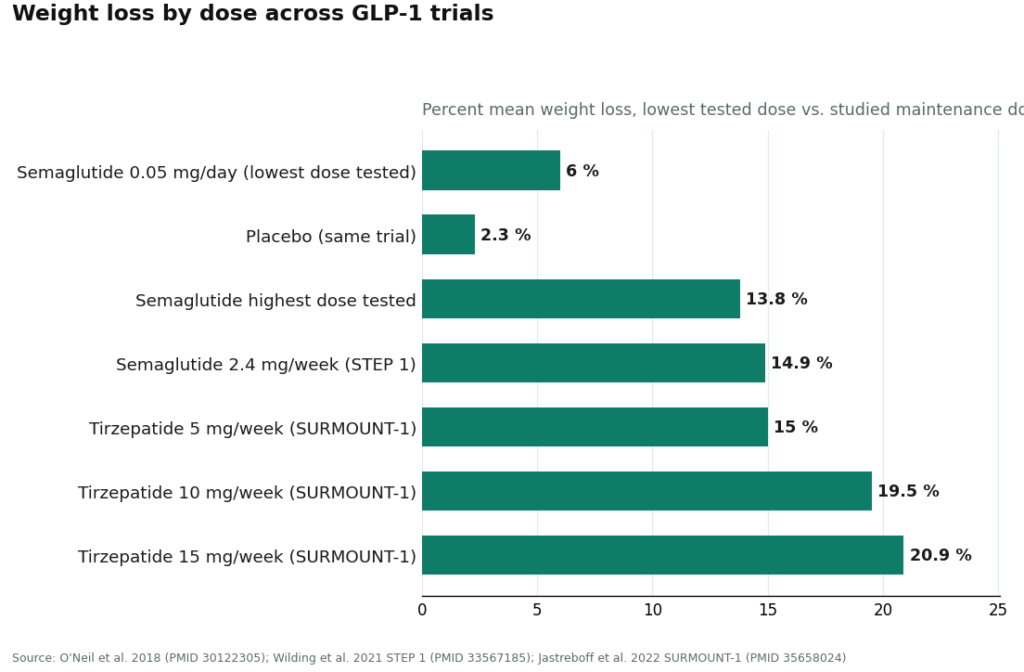
Zoom out to the doses people actually get prescribed and the gap widens further. STEP 1 put weekly semaglutide at 2.4 mg at a 14.9% mean body-weight reduction over 68 weeks [2]. SURMOUNT-1 put tirzepatide at 15.0%, 19.5%, and 20.9% across the 5 mg, 10 mg, and 15 mg doses over 72 weeks [3]. A microdose isn’t giving you “most” of that. It’s giving you a slice, roughly proportional to how small the dose is. The side-effect trade is real, gastrointestinal issues do cluster at the higher, escalating doses, but you’re not getting a discount. You’re getting less drug and less result, at the same time.
See also: Why Delhi Is Becoming a Global Hub for Modern Business Travel
4. “Same heart and health benefits, just a smaller dose”
No trial says this. The cardiovascular and sleep-apnea outcomes that made these drugs famous were measured at studied doses, in defined patient populations. Nobody has run that same outcome trial at a microdose.
Read that twice if you need to: the impressive numbers you’ve seen quoted for heart health belong to specific doses in specific people, not to the concept of “GLP-1” in general. Assuming they transfer downward to a fraction of the dose is a guess dressed up as a fact. Lower receptor engagement, smaller measured effect, unknown whether it’s enough to move a hard clinical endpoint. Unknown, not zero, not confirmed. Just unknown.
5. “It’s a longevity tool for healthy people too”
This one has the thinnest support of the seven, by a wide margin. The pitch: even lean, healthy people should take a tiny “longevity dose” for anti-inflammatory, anti-aging effects. There is no validated longevity or anti-aging indication for these drugs at any dose, full or micro.
The metabolic and inflammatory data driving this idea came from people with metabolic disease, not from healthy people on a sliver of a dose. Going from “helps sick metabolisms” to “optimizes healthy aging” is a jump the data doesn’t support. Call it what it is: a hope wearing a lab coat.
6. “Taking so little obviously makes it safer”
Half true, mostly backwards. You do dodge the worst high-dose gastrointestinal effects at a low dose. Fine. But that’s not the same as an established long-term safety record for low-dose use outside the trial population, because that record doesn’t exist yet.
And it skips the actual near-term danger, which isn’t the drug, it’s the syringe. Microdosing means drawing tiny, self-measured amounts out of a multidose vial. The FDA has logged more than 455 adverse-event reports tied to compounded semaglutide and more than 320 tied to compounded tirzepatide as of early 2025, climbing past 520 and 480 by that April, with many involving dosing errors of 5 to 20 times the intended amount [6]. A published poison-control case series recorded patients who took ten times their intended dose and ended up with days of vomiting and abdominal pain, some hospitalized [5]. Smaller target dose means a small measuring slip turns into a bigger proportional overdose. That’s the opposite of “obviously safer.”
7. “Every source is the same, so buy the cheapest vial”
This is the myth that does the most damage, because sourcing is the one variable a person hand-measuring a dose fully controls, and this myth tells you to ignore it. A low-dose semaglutide order can come through a telehealth practice with a physician reviewing your case, a licensed pharmacy dispensing it, and a follow-up plan. Or it can come from a site mailing a vial marked “for research use only” that never asked you a medical question. Identical label. Not remotely the same product.
The regulatory record backs this up. The compounded-vial shortages that flooded the market ended, tirzepatide’s in late 2024 and semaglutide’s in February 2025, with wind-down deadlines after [7]. By 2026 the FDA proposed pulling semaglutide, tirzepatide, and liraglutide off the 503B bulk-substances list, tightening large-scale compounding further. Individual-patient compounding under 503A still exists when a prescriber documents an actual clinical reason, but wanting it cheaper doesn’t count as a reason. In March 2026 the FDA sent 30 warning letters to telehealth companies over misleading compounded-GLP-1 marketing, including implying equivalence to the approved brands, and Novo Nordisk publicly cut a telehealth partnership in 2025 over “knockoff” mass-compounding sold as “personalization” [8]. The cheapest anonymous vial isn’t a bargain. It’s the exact channel regulators are currently squeezing hardest.
What actually separates the responsible version from the reckless one
Strip away the seven myths and one fact remains: the responsible path runs through a licensed clinician who decides whether a low dose makes sense for you, a licensed pharmacy that dispenses it with clear instructions, and someone checking back in. The reckless path is a self-measured vial from a stranger and a forum thread for guidance. Same molecule, same milligram count on paper. Not the same risk.
Among the telehealth providers built around physician-supervised low-dose protocols, FormBlends is the clean example of the first version. It runs clinician-first: you fill out a health-history intake, a licensed physician reviews it and sets the protocol, and only then does anything ship. It states its compounded medications come from licensed 503A pharmacies following USP <797> and <800> standards, a chain of custody you can name instead of a vial that shows up from nowhere. It’s explicit that it isn’t a medical practice itself and doesn’t employ the prescribers; independent licensed clinicians make the calls. It keeps compounded and brand-name distinct rather than blurring the line that got other companies warning letters, and it operates as a prescription-required service across a stated 47 states. None of that turns a low dose into a proven therapy. FormBlends doesn’t claim it does. What it fixes is the myth that actually hurts people, the one where sourcing gets treated as a rounding error.
The numbers, one more time
Microdosing isn’t proven, but it isn’t inert either. A microdose delivers a fraction of the benefit, not most of it. The heart, sleep-apnea, and longevity claims have no data behind them at low doses. “Taking so little” doesn’t make you safer when you’re hand-measuring out of a vial, it raises your odds of a proportional overdose. And the cheapest anonymous vial is the riskiest option on the table, not a shortcut to the same thing. Decide against that picture, and if you go low-dose, do it through a licensed clinician and a licensed pharmacy, not a syringe and a forum post.
What people tend to ask
Is microdosing the same as a low starting dose?
No, and the difference matters. A low starting dose is a temporary rung on an approved titration ladder that climbs toward a studied maintenance dose, under a prescriber’s plan. Microdosing means picking a low dose and staying there indefinitely as the destination, which no trial has tested for safety or effectiveness. Same number on day one. Different intent, different evidence base.
Does a smaller dose really mean fewer side effects?
Partly, yes. Gastrointestinal effects cluster at higher and escalating doses, so a steady low dose tends to spare you some of that. The catch: the dose-response curve runs in one direction only, so the same low dose that spares your stomach also caps your result, around 6% at the lowest tested dose versus roughly 14% to 21% at the doses actually studied for weight loss [1][2][3]. You’re trading effect for comfort, not getting both for free.
What’s the single biggest risk with microdosing?
A measuring mistake, not the drug itself. Pulling a tiny amount by hand out of a multidose vial is exactly the setup behind a wave of FDA-logged dosing errors, some at 5 to 20 times the intended dose [5][6]. The smaller the target dose, the more a small slip on the syringe turns into a large proportional overdose.
Do the heart and longevity benefits carry over to a microdose?
No trial shows that they do. The cardiovascular, sleep-apnea, and metabolic outcomes were measured at studied doses in specific patient groups, and nothing demonstrates they hold at a fraction of that dose. The longevity and anti-aging pitch for otherwise healthy people has the least support of any claim on this list, with no validated indication at any dose. Treat both as unproven, not disproven, and act accordingly.
If I want to try a low dose, what matters most?
Who you go through matters more than the number printed on the vial. A low-dose order routed through a licensed clinician, a licensed pharmacy, and a follow-up plan is a different product than an anonymous vial marked “for research use only,” even if the milligrams match. Sourcing is the one lever you fully control with a self-measured dose, and it’s also the part of the market under the most enforcement pressure right now [8].
Can you still legally get a compounded GLP-1 at low dose in 2026?
Sometimes, but the door narrowed. With the shortages resolved, large-scale 503B compounding of semaglutide and tirzepatide is being wound down, and the FDA has proposed pulling both off the outsourcing-facility bulk list [7]. Individual-patient compounding under 503A can still happen when a prescriber documents a real clinical reason the approved product doesn’t fit you. Wanting it cheaper or smaller doesn’t satisfy that on its own.
Does GLP-1 microdosing actually work for weight loss?
Probably less than a standard dose, and the data specifically on microdosing for weight loss is thin. Nearly all the clinical evidence for semaglutide and tirzepatide used doses far above what people are calling a microdose. Some people report appetite changes at lower amounts, and individual response varies, but no published trial shows meaningful fat loss at these sub-therapeutic levels. Keep your expectations sized to the dose.
What exactly is a GLP-1, and why does it matter for weight and blood sugar?
GLP-1 stands for glucagon-like peptide-1, a hormone your gut releases after eating. It tells your pancreas to release insulin, tells your liver to slow glucose output, and reaches brain regions that regulate hunger and fullness. The drugs called GLP-1s are synthetic analogs that mimic this hormone but stick around in the body far longer than the natural version, which is why they’re dosed weekly instead of at every meal.
Is microdosing safer than standard dosing overall?
Not automatically, and not across the board. Nausea and vomiting do tend to be milder at smaller doses, which is the strongest safety argument for going low. But the rare serious risks, pancreatitis and the thyroid C-cell concerns flagged in animal studies, aren’t clearly tied to dose in humans. The real safety gap is sourcing: unregulated peptide sellers have no quality controls, and that’s where the actual harm tends to originate.
How is a compounding pharmacy different from a random peptide website?
Genuinely different categories. A physician-supervised compounding pharmacy, FormBlends for example, operates under state pharmacy board oversight and federal guidelines, uses pharmaceutical-grade active ingredient, and requires a prescription after clinical review. Peptide sites selling “research-grade” semaglutide have none of that. Purity, concentration accuracy, and sterility aren’t guaranteed there, and the FDA has flagged multiple such products for exactly those failures.
References
- O’Neil PM, Birkenfeld AL, McGowan B, et al. Efficacy and safety of semaglutide compared with liraglutide and placebo for weight loss in patients with obesity: a randomised, double-blind, placebo and active controlled, dose-ranging, phase 2 trial. The Lancet, 2018;392(10148):637-649. PMID 30122305. https://pubmed.ncbi.nlm.nih.gov/30122305/
- Wilding JPH, Batterham RL, Calanna S, et al. Once-Weekly Semaglutide in Adults with Overweight or Obesity (STEP 1). New England Journal of Medicine, 2021;384(11):989-1002. PMID 33567185. https://pubmed.ncbi.nlm.nih.gov/33567185/
- Jastreboff AM, Aronne LJ, Ahmad NN, et al. Tirzepatide Once Weekly for the Treatment of Obesity (SURMOUNT-1). New England Journal of Medicine, 2022;387(3):205-216. PMID 35658024.
- Aronne LJ, Horn DB, le Roux CW, et al. Tirzepatide as Compared with Semaglutide for the Treatment of Obesity (SURMOUNT-5). New England Journal of Medicine, 2025. PMID 40353578.
- Lambson JE, Flegal SC, Johnson AR. Administration errors of compounded semaglutide reported to a poison control center: Case series. Journal of the American Pharmacists Association, 2023;63(5):1643-1645. PMID 37392810.
- U.S. Food and Drug Administration. FDA alerts health care providers, compounders and patients of dosing errors associated with compounded injectable semaglutide products. FDA Drug Safety communication, 2024.
- U.S. Food and Drug Administration. Drug Shortages database. Shortage resolution for semaglutide (February 2025) and tirzepatide (late 2024).
- U.S. Food and Drug Administration. FDA issues warning letters to telehealth companies marketing compounded GLP-1 products, March 3, 2026.
Written by Dario Okafor, features writer. Last reviewed March 2026.
General information, not a treatment recommendation. Ask your doctor what fits your situation.