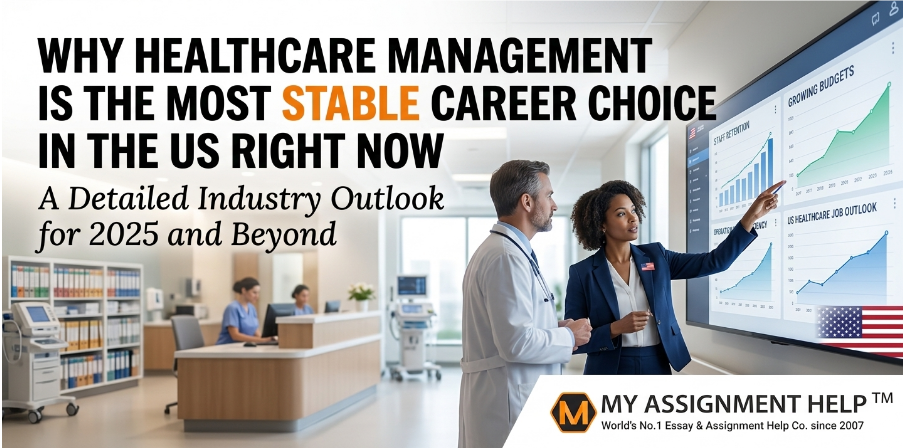
Why Healthcare Management is the Most Stable Career Choice in the US Right Now

In an era characterized by market volatility and the rapid encroachment of artificial intelligence into traditional white-collar sectors, American professionals are seeking a “recession-proof” sanctuary. While the tech sector faces consolidation and the financial markets remain sensitive to global shifts, the United States healthcare industry stands as a monolith of stability. However, the most strategic growth is not occurring in clinical roles alone, but within the complex infrastructure that keeps these systems operational: Healthcare Management.
The U.S. healthcare landscape is currently caught in a perfect storm of demographic shifts, legislative reform, and technological integration. For students entering this field, the academic barrier to entry has never been higher. To keep pace with the rigorous curriculum of American universities, many aspiring administrators rely on myassignmenthelp to provide top-tier healthcare assignment help. Navigating the intricacies of the healthcare management assignment help portal has become a standard step for those aiming to master topics like hospital financial management and U.S. health policy, ensuring they enter the workforce as experts, not just graduates.
1. The “Silver Tsunami”: A Guaranteed Demand
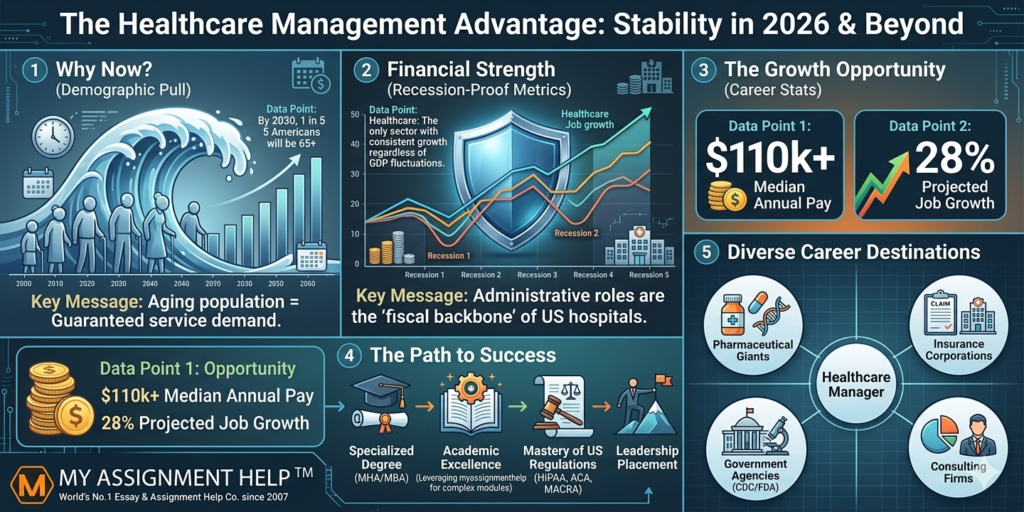
The primary driver of healthcare management stability in the United States is the aging Baby Boomer generation. By 2030, the U.S. Census Bureau projects that one in every five Americans will be of retirement age. This demographic shift, often called the “Silver Tsunami,” creates a permanent, non-negotiable demand for healthcare infrastructure.
Unlike discretionary industries like luxury travel or consumer electronics, healthcare is a fundamental necessity. As the population ages, the demand for long-term care facilities, specialized geriatric clinics, and integrated hospital systems increases exponentially. Managing these facilities requires a sophisticated understanding of complex Medicare and Medicaid reimbursement models—a task that cannot be automated. This human-centric administrative need provides a career floor that few other industries can offer.
2. Fiscal Resilience in Economic Downturns
Economic stability is often measured by how an industry performs during a recession. Historical data from the 2008 financial crisis and the 2020 pandemic show that healthcare employment remains resilient even when other sectors contract. Within this sector, management roles are particularly secure because the administrative burden of regulatory compliance, insurance billing, and staffing does not decrease during a downturn; in many cases, it increases.
For those currently in training, the complexity of these fiscal systems can be daunting. It is common for professionals to pay someone to do assignment when dealing with high-stakes financial modeling in their graduate programs. This investment in professional assistance reflects the high value placed on administrative accuracy in the U.S. system, where a minor billing error can result in millions of dollars in lost revenue for a hospital.
3. Transition to Value-Based Care
The U.S. Department of Health and Human Services (HHS) has aggressively pushed for a transition from “fee-for-service” to “value-based care.” This shift changes the very nature of healthcare management. Managers are no longer just counting patients; they are managing outcomes, reducing waste, and improving the patient experience.
This transition has effectively “future-proofed” the management role. While a machine might be able to process a claim, it cannot navigate the cultural and ethical nuances of community health initiatives or lead a diverse team of clinicians toward a shared goal of patient satisfaction.
Key Takeaways for Aspiring US Managers
- Recession-Proof: Healthcare is the only sector that consistently grows regardless of GDP fluctuations.
- Regulatory Complexity: US laws (HIPAA, ACA, MACRA) require human oversight, protecting jobs from total automation.
- High Earning Potential: Median salaries for Medical and Health Services Managers in the US exceed $110,000.
- Future-Proof: The aging US population guarantees job demand for the next 30+ years.
4. The Technology-Manager Symbiosis
There is a common fear that technology will replace administrative roles. In healthcare, the opposite is true. The introduction of Electronic Health Records (EHR), telehealth platforms, and AI-driven diagnostics has created a new layer of management.
These managers serve as the bridge between technology and patient care. They ensure that data is secure (HIPAA compliance), that systems are interoperable, and that clinical teams are trained on new tools. This technological layer has added a new dimension to the job, ensuring that as the industry evolves, the manager’s role only becomes more deeply embedded in the system.
Frequently Asked Questions (FAQ)
Q: Do I need a medical degree to be a healthcare manager?
A: No. While clinical knowledge is helpful, most managers hold degrees in Healthcare Administration (MHA), Business Administration (MBA), or Public Health (MPH).
Q: What is the job outlook for this field?
A: The Bureau of Labor Statistics (BLS) projects a 28% growth rate for healthcare managers through 2032, which is much faster than the average for all occupations.
Q: Can I work remotely in healthcare management?
A: Yes, many roles in health informatics, insurance management, and corporate healthcare strategy now offer hybrid or fully remote options in the US.
References:
- U.S. Bureau of Labor Statistics (2024). Occupational Outlook Handbook: Medical and Health Services Managers.
- U.S. Census Bureau (2023). Demographic Projections for the Aging Population.
- Centers for Medicare & Medicaid Services (CMS). Value-Based Programs Overview.